Mariner who work for an employer get their sea service documentation from their employers. Maritime employers are responsible for keeping accurate records of their employees' sea service, including the dates, vessel type and name, and capacity in which the employees served.

Who needs to provide sea service documentation for their crews?
The following types of employers and operators are typically required to provide sea service documentation to their employees:
Vessel operation companies: Any company that operates commercial vessels is required to maintain records of their employee's sea service and to provide sea service documentation to employees upon request. This includes every maritime company that operates vessels commercially from the largest ships operated in the US to the smallest passenger vessel ferries - and everything in between.
Vessel owners: If you own your own vessel and people on your vessel are assisting in safe navigation of the vessel for over 4 hrs in a 24 hr period you are typically required to maintain records of their sea service and to provide sea service documentation to them upon request.
Why is sea service documentation important?
Sea service documentation is a critical component of an individual's qualifications for a United States Coast Guard (USCG) license or endorsement, and must be accurate and verifiable. Employers are responsible for ensuring that their employees have the necessary sea service documentation to meet USCG licensing requirements.
Sea service days are used to measure a mariner’s lifetime experience on boats, whether recreational, commercial, or military. Documented sea service days accumulate over a lifetime as a mariner and never expire.
Best practices for providing sea service letter documentation:
Because a mariner's career depends on the accumulation of documented sea service it is in the best interest of the company and the mariner to provide sea service documentation to a mariner once a year, and when a mariner hits critical sea time goals relative to their career.
What types of Sea Service Documentation is there for the US?
There are three main types of sea service documentation that can be used for a mariner depending on the size of the vessel they are working on. A USCG CG-719S form, a Sea Service Letter on Company Letterhead or a Certificate of Discharge (COD) form can be used.
CG-719S for vessels under 200 GRT:
If you own your own boat or you are providing sea service documentation for someone on a vessel less that 200 GRT you can use a CG-719S Small Vessel Sea Service Form. Just make sure the vessel is under 200 GRT or it will not be accepted by the USCG.
Sea Service Letter on Company Letterhead:
Sea Service Letters on Company Letterhead are the most commonly produced sea service documentation for mariners working at commercial companies that operate vessels.
The letter needs to include all of the information required by 46 CFR 10.232 for sea service letter on company letterhead, and must include all of the the following information:
- Mariners Name
- Mariners Last Four of their Social or full MMC Reference Number
- Vessel Name
- Official Number
- Vessel Type - Pick one of the list below (Motor is most common)
- Motor
- Sail
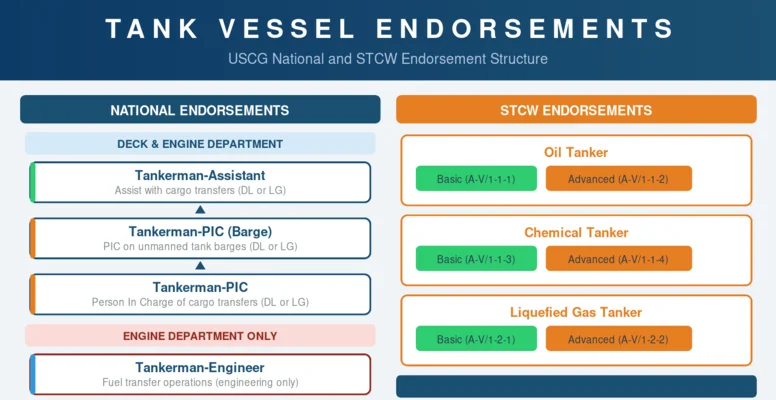
- Tank Ship or Barge - There are four main types of Tankers
- Tank Ship (liquified gasses)
- Tank Ship (dangerous liquids)
- Tank Barge (liquified gasses)
- Tank Barge (dangerous liquids)
- Towing
- High Speed Craft
- Offshore Installation - There are three types of Offshore Installations
- Mobile Offshore Drilling Unit -There are two types of MODUs
- Bottom Bearing Unit
- Surface Unit - There are three types of MODU Surface Units
- Self Propelled
- Propulsion Assisted
- Non-Self-Propelled
- Floating Offshore Installation - There are two types of Floating Offshore Installations
- Active Ballast
- Passive Ballast
- Fixed Platform
- Freight
- Liftboat
- Propulsion Type - There are three types of of Propulsion the USCG recognizes
- Motor
- Steam
- Gas Turbine
- Tonnage -
- GRT (Always provide GRT if known. It makes life the easiest with the USCG)
- GT
- NRT
- Engine Horsepower
- The Beginning Date of Service
- The End Date of Service
- Number of Underway Days
- Number of Days
- 8hr or 12 hr days
- There are a few very special vessels which are listed in listed in 46 U.S.C. 8104 and 46 CFR 15.705, or authorized by their COI, who are authorized to operate a two-watch system, a 12-hour working day may be creditable as 1.5 “days” of service only on those vessels. If the vessel is only authorized by their COI we strongly recommend you provide the COI for that vessel every time you interact with the USCG for licensing.
Who can sign my sea service letter on company letterhead?
There are four main positions at your organization who can sign your sea service letter on company letterhead. It can be the ship’s master, owner, vessel manager or office staff.
You cannot sign for yourself on a sea service letter on company letterhead.

We hope this made your life a little easier and if you have other questions the MM-SEAS team is always here to help!
MM-SEAS is free to use on your own and if you need some more personalized help you can upgrade to MM-SEAS Expert Access inside of the site.
No matter what, when you are ready to submit your application you can do it yourself, or you can hand the whole thing to us. An MM-SEAS Navita Navigator walks you through submitting in Navita, the Coast Guard's new submission portal, on a short video call. No computer, or not up for a video call? Our team gets your application submitted to the Coast Guard for you anyway. A Stress-Free MMC is $399. Two MM-SEAS licensing experts check every page, we pay your Coast Guard fees at submission and charge your card so you never touch pay.gov, and we stay on it with the National Maritime Center until your credential is issued.
MM-SEAS Expert Access is $99 a year. It is your personal guidance counselor for USCG licensing: what training you need next, which sea time counts, and how to reach the credential you want, by phone, email, chat or a 1 on 1 video call. Expert Access members also get $50 off a Stress-Free MMC.
Need to renew, upgrade or get your first USCG license? We're here to help.
About the author

Nate Gilman is President and Co-Founder of MM-SEAS. He hawsepiped from the deck to a 3rd Mate Unlimited license with full STCW compliance over more than 15 years at sea, and is a veteran of the NOAA Commissioned Corps. He works directly with the National Maritime Center, USCG-approved training schools, and vessel operators on credentialing policy, and writes on sea service documentation, evaluation standards, and how mariners move up the license ladder.